
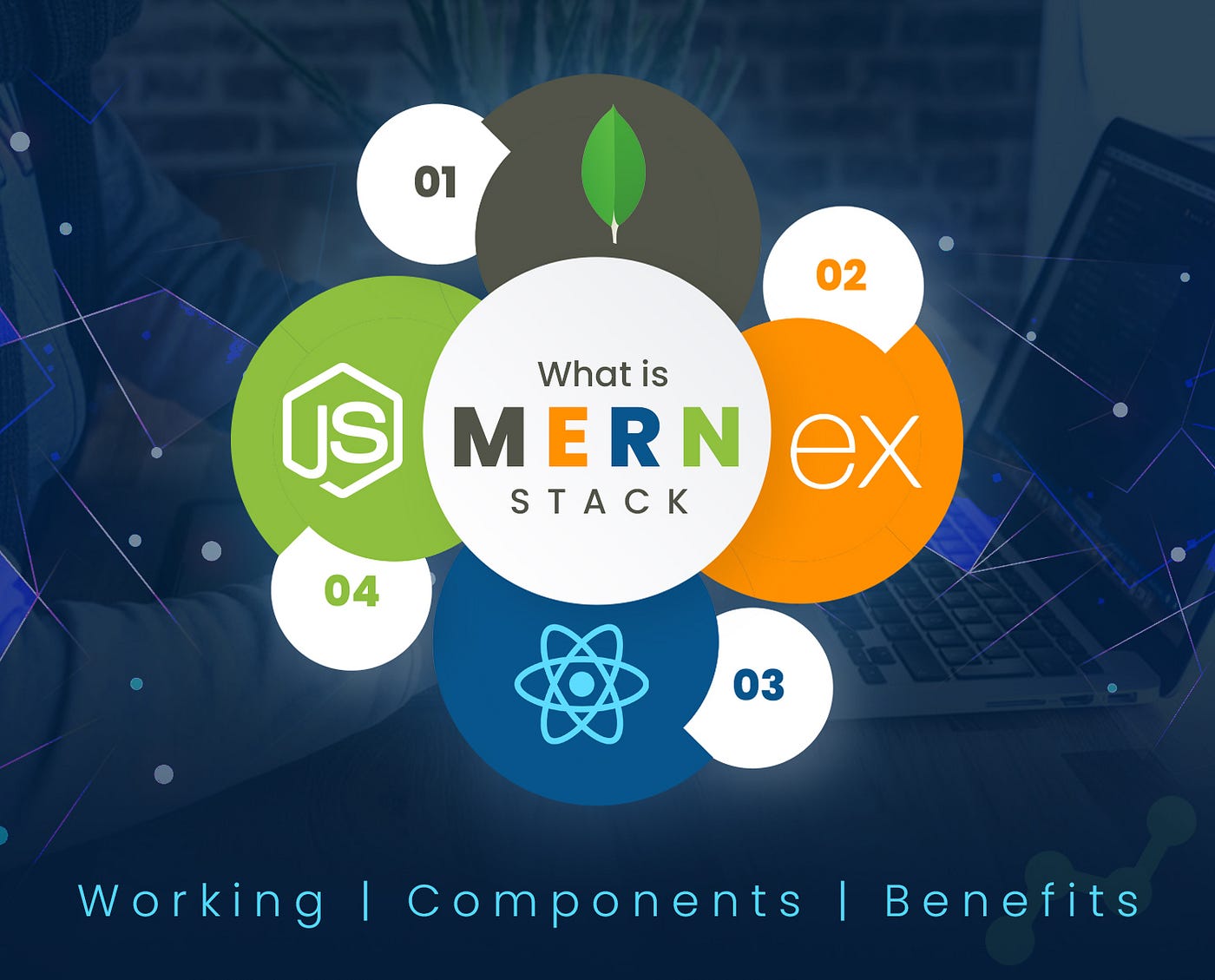
The MERN stack (MongoDB, Express.js, React.js, and Node.js) is an essential toolset for modern web development, powering full-stack applications with flexibility and efficiency. Whether you're preparing for an interview or simply brushing up on your skills, here's a thorough guide to key MERN stack interview questions, along with their answers.
MongoDB Questions
1. What is MongoDB?
MongoDB is a NoSQL database that uses a flexible, document-based data model, allowing for efficient storage and retrieval of JSON-like documents.
2. What are the key features of MongoDB?
Key features include its schema-less design, horizontal scalability through sharding, support for ad-hoc queries, indexing, replication, and high availability.
3. What is a document in MongoDB?
A document in MongoDB is a basic unit of data that stores information in a key-value pair format, similar to JSON objects.
4. What is a collection in MongoDB?
A collection is a group of MongoDB documents, which is similar to a table in relational databases but without enforced schema.
5. What is the difference between MongoDB and a relational database?
MongoDB is schema-less and stores data in documents, whereas relational databases rely on predefined schemas and store data in rows and tables. MongoDB scales horizontally, while relational databases typically scale vertically.
6. What is an index in MongoDB?
Indexes in MongoDB are used to improve the efficiency of query operations by allowing the database to quickly locate data without scanning every document.
7. What is replication in MongoDB?
Replication in MongoDB is a process that allows data to be duplicated across multiple servers, ensuring redundancy, high availability, and failover capabilities.
8. What is sharding in MongoDB?
Sharding is a method for distributing data across multiple machines to scale horizontally, which allows MongoDB to handle large datasets.
9. How does the aggregation framework work in MongoDB?
The aggregation framework processes data records and returns computed results, enabling complex operations such as filtering, grouping, and transforming data in a pipeline approach.
10. How do you perform a backup and restore in MongoDB?
Backups can be performed using mongodump, which creates a backup of the database, and restores using mongorestore, which restores the backed-up data.
Express.js Questions
1. What is Express.js?
Express.js is a minimal, fast, and flexible Node.js web application framework that provides essential features for building web and mobile applications.
2. What are the main features of Express.js?
Key features include middleware support, robust routing, HTTP helpers for handling requests, views support for templating engines, and simplified server setup.
3. How do you create a simple server using Express.js?
To create a server:
const express = require('express');
const app = express();

app.get('/', (req, res) => {
  res.send('Hello World!');
});

app.listen(3000, () => {
  console.log('Server is running on port 3000');
});
4. What is middleware in Express.js?
Middleware functions are functions that have access to the request object, response object, and the next middleware function. They are used for tasks such as logging, authentication, and handling requests.
5. How do you define routes in Express.js?
Routes are defined using methods like app.get(), app.post(), app.put(), etc., to handle HTTP requests for different paths.
6. How do you handle errors in Express.js?
Error-handling middleware can be defined with four arguments: err, req, res, next. This middleware is used to handle any errors that occur during request processing.
7. What is the role of the next function in middleware?
The next function is used to pass control to the next middleware function in the stack. If next() is not called, the request will hang.
8. How do you handle form data and file uploads in Express.js?
Form data and file uploads can be handled using middleware like body-parser for form data and multer for file uploads.
9. How can you manage different environments (development, production, etc.) in an Express.js application?
Environments can be managed by setting environment variables, using the process.env.NODE_ENV variable to switch configurations.
10. What are some common security best practices when using Express.js?
Some best practices include using HTTPS, validating and sanitizing user input, preventing SQL injection, using secure cookies, setting appropriate HTTP headers, and implementing CORS policies.
React.js Questions
1. What is React.js?
React.js is a JavaScript library used for building interactive user interfaces, primarily for single-page applications. It allows developers to create reusable components.
2. What are the main features of React.js?
React’s main features include its component-based architecture, virtual DOM for efficient rendering, JSX syntax for HTML-like code, and the use of hooks for managing state and side effects.
3. What is JSX?
JSX is a syntax extension for JavaScript that allows you to write HTML directly within JavaScript code. React uses JSX to describe UI components.
4. What are components in React.js?
Components are the building blocks of React applications. They can be class components or functional components, and they represent pieces of the UI.
5. What is the difference between functional and class components?
Functional components are stateless and simple, while class components are more feature-rich and can hold and manage state. With the introduction of hooks, functional components can also manage state and side effects.
6. What is state in React.js and how is it used?
State represents a component’s dynamic data, which can change over time. State is managed within the component and can be updated using setState (for class components) or the useState hook (for functional components).
7. What are props in React.js and how do they differ from state?
Props (short for properties) are read-only values passed from parent to child components, whereas state is local to a component and can be modified within the component.
8. What is the virtual DOM and how does React use it?
The virtual DOM is a lightweight in-memory representation of the real DOM. React uses the virtual DOM to optimize updates by only re-rendering parts of the UI that have changed.
9. What are React hooks and name a few commonly used hooks?
React hooks allow functional components to manage state and lifecycle methods. Commonly used hooks include useState, useEffect, useContext, and useReducer.
10. How do you manage side effects in React.js?
Side effects, such as fetching data or updating the DOM, are managed using the useEffect hook, which allows you to run code after the component renders.
Node.js Questions
1. What is Node.js?
Node.js is a JavaScript runtime built on Chrome's V8 engine. It is used to build fast and scalable server-side applications with non-blocking, event-driven architecture.
2. What are the main features of Node.js?
Node.js is known for its non-blocking, asynchronous I/O operations, single-threaded event loop, scalability, and vast package ecosystem via npm.
3. How does Node.js handle asynchronous operations?
Node.js uses an event-driven architecture, where asynchronous operations are handled through callbacks, promises, or async/await syntax.
4. What is the event loop in Node.js?
The event loop is a mechanism that allows Node.js to handle asynchronous operations. It continuously checks for events and executes the associated callbacks.
5. What are streams in Node.js and how are they used?
Streams are objects used to read or write data in a continuous manner. They are used in Node.js to process large amounts of data without loading it all into memory at once (e.g., file handling, network communication).
6. What is the difference between process.nextTick() and setImmediate()?
process.nextTick() schedules a callback function to execute at the beginning of the next event loop, while setImmediate() executes the callback after the current event loop completes.
7. How do you handle errors in Node.js?
Errors in Node.js can be handled using try-catch blocks, error-first callback patterns, or by using event listeners (e.g., error events on streams).
8. What are some common use cases for Node.js?
Common use cases include building web servers, real-time applications (e.g., chat apps), APIs, microservices, and handling I/O-heavy tasks.
9. What are modules in Node.js and how do you use them?
Modules in Node.js are reusable blocks of code. They can be core modules (like fs or http), third-party modules, or user-defined modules. You can import a module using require() and export it using module.exports.
10. How do you manage package dependencies in a Node.js project?
Package dependencies are managed through npm, the Node.js package manager. Packages can be installed using npm install, and dependencies are listed in the package.json file.
By reviewing these core concepts and understanding the answers to these MERN stack questions, you'll be more confident during your interviews or when tackling full-stack web development